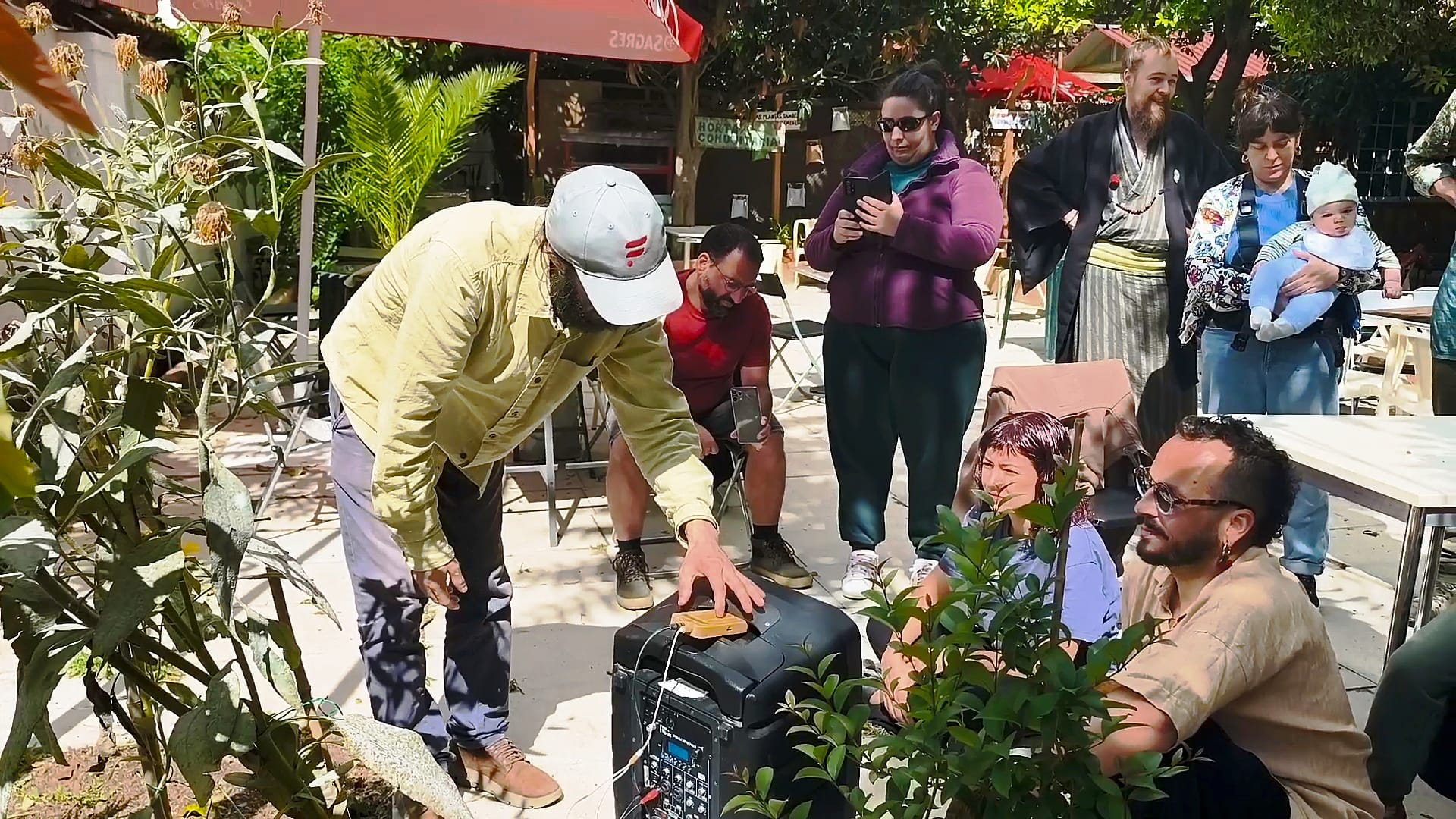
Last Sunday, 17 May, we took part in the Coopera Festival (https://confe.coop/coopera-futuros-em-rede/) with Plant Music..
We encountered a curious and engaged community, and the conversation flowed like a river through nature…
Everything vibrates — including plants
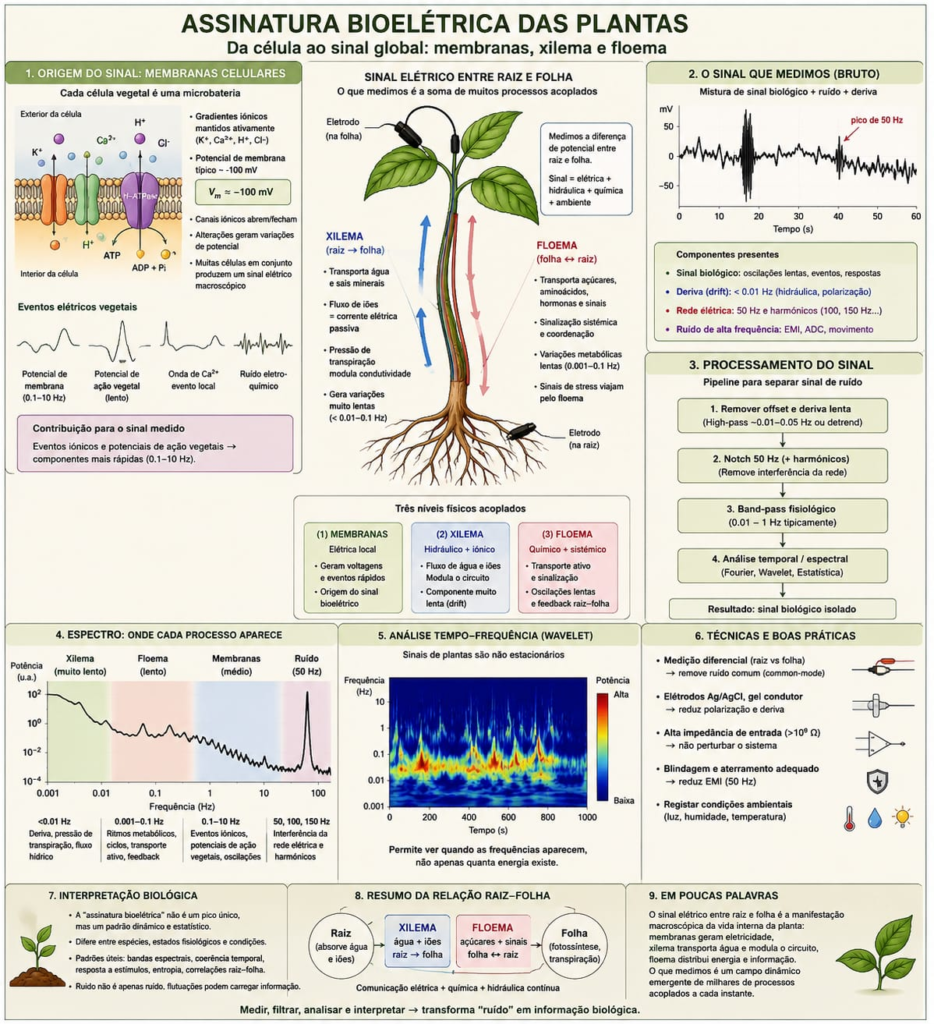
According to certain principles of quantum physics and bioenergy, all matter vibrates at a particular frequency. Plants, as living organisms, have their own resonant frequencies. Their physiological processes — such as the movement of sap, photosynthesis and the opening of stomata — generate micro-vibrations. Although imperceptible to the human ear, these signals are present and may influence the surrounding environment.
Listen here: https://www.youtube.com/shorts/KKXI8xBWEzg
Subtle communication
We already know that plants communicate with one another through chemical signals (pheromones and volatile organic compounds) and electrical signals. There are also hypotheses suggesting that they emit low-frequency acoustic waves, sometimes referred to as plant bioacoustics, which can be detected using highly sensitive sensors. These sounds could be described as the "whispers of the forest", emitted at frequencies below 20 Hz — known as infrasound.
Sensitivity and Perception
Plants perceive their environment with remarkable sensitivity: light, temperature, humidity, touch and, according to some studies in bioelectrography and experiments such as those conducted by Cleve Backster in the 1960s, even human intention. This reinforces the idea that plants exist in a state of conscious vibration, silently responding to the world around them — or rather, through frequencies that we cannot hear.
Music as a metaphor for plant life
When we transform these vibrations into audible sounds, we are translating the plant's energetic state into a language humans can understand: music. In this sense, saying that a plant "makes music" may be poetically true. It expresses its presence, internal rhythms and interaction with its surroundings through vibrations that resemble what we call music, albeit in an unconventional form.
So, what next?
Perhaps the most interesting aspect of this experience was precisely the curiosity it sparked around something so simple, yet so often overlooked.
Taking the time to listen to what usually goes unheard, to notice what often goes unnoticed, and to make room for new ways of paying attention to life and the natural world. Ultimately, rather than providing definitive answers, what remained was an encounter — between people, nature and imagination — leaving us with a thought-provoking question: What if material reality itself, with all its different scales and processes, were in some way like a song.